
Customs bonded warehousing in Portland and St. Louis gives you a way to put time back on your side when freight lands early or isn’t ready to release.
A bonded warehouse is not just where freight sits and waits. It is where you get time back on your side.
Sometimes the container lands before the buyer is ready. Sometimes you want to stage product instead of releasing everything at once. Sometimes it is simply too early to make a smart decision about duties, storage, and the next move. In those moments, bonded storage is not an extra option on the rate sheet. It is how you keep a shipment from forcing your hand.
That is why customs bonded warehousing matters. Not because it sounds strategic in a presentation, but because it gives you room to line up timing, paperwork, cash flow, and downstream planning. Without losing control in the process.
What is a customs bonded warehousing?
Technically, a customs bonded warehouse is a secured facility where imported goods can be stored before you pay duty. That is the textbook version.
In practice, it is a place where freight can arrive, stay under control, and wait for the next move that actually makes sense for your operation. Your team does not have to push cargo into immediate release just because it hit the port. You can hold inventory while orders firm up, let distribution plans settle, wait for documentation to clear, and make inventory decisions with more discipline instead of reacting to an arrival date.
Bonded warehousing does not change what you sell. It changes when you have to decide what happens next.
 Why do shippers use bonded storage?
Most of the time, the reasons are simple.
The product is here, but the timing is wrong. The buyer is not ready. You want to stagger inventory into the network instead of flooding it. You are still weighing what makes sense on duties and cash flow. Or you just need the shipment to stay put and stay secure while you figure out where it actually belongs.
That is the real advantage of bonded space: time, without letting go of the wheel.
A bonded warehouse gives you breathing room inside a controlled operation. Not a yard, not a parking lot, and not a black box you cannot see into. You get a buffer between “freight arrived” and “freight released,” with your product tracked, inventoried, and ready when you are.
The advantage is not storage alone
Anyone can talk about square footage. Anyone can stack pallets.
The point is what bonded warehousing lets you do with that space. Defer duty until release, instead of paying everything at once. Hold imported goods in a secure environment while the rest of your plan catches up. Stage freight before you send it downstream so you are not asking a distribution center to sort out a rush of mismatched arrivals. Keep product tied to a plan instead of letting the schedule be set by vessel ETAs and last-minute favors.
When it is run well, a bonded warehouse does more than buy you time. It buys you organized time.
You know where freight is, how long it has been there, what is cleared, and what is waiting on a decision. You are not guessing. You are not refreshing a tracking page and hoping.
Why execution matters more than the designation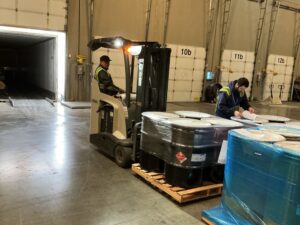
On paper, “customs bonded” is a status. In the real world, the designation does not save a bad operation.
If receiving is loose, if inventory is hard to track, if paperwork does not match what is on the floor, or if updates dry up when something changes, the bonded label does not help you much. The freight is still hard to manage. The problems just take place inside a more regulated box.
This is where Bridgetown’s background matters.
Bridgetown did not start as a warehouse trying to add trucking on the side. It is an asset-based freight company that runs both trucks and warehouses and keeps the same freight in hand across more than one stage. Warehousing came into the picture because customers needed more than point-to-point moves. They needed staging. They needed storage control. They needed a team that would stay responsible for freight between arrival and final delivery, not hand it off and walk away.
That broader operating model is still the point. Bonded warehousing is not a side service here. It lives inside a larger freight operation that also includes transportation and certified warehouse handling, all built to work together instead of as separate projects.
Why Portland and St. Louis matter
Location is not a footnote in bonded warehousing. It changes what your options look like.
Portland makes sense for freight moving through the West Coast and into the Pacific Northwest. If you are importing through this region, keeping bonded inventory close to the port and close to your next legs cuts down on unnecessary touches and empty miles. It means your containers do not have to travel far before they are under control in a building you can trust.
St. Louis matters for a different reason. Many Bridgetown customers need the same discipline, the same dock-to-road follow-through, and the same bonded capabilities in the Midwest that they have in Portland. They do not want one standard in the Northwest and a lower one in the middle of the country. They do not want to explain their operation twice.
Bridgetown did not build St. Louis as a branding move. It is our answer when customers asked Bridgetown to bring the same standard to another region.
Two bonded regions only help you if the work is done to the same standard in both places. That is the promise that matters: you get the same level of control and communication whether your freight is sitting in Portland, Oregon or St. Louis, Missouri.
Where bonded warehousing fits for food imports and other sensitive freight
For some shipments, “just put it in storage” is not good enough.
If you are moving food products, ingredients, or anything that cannot be handled casually, the warehouse decision carries more weight. Storage conditions, documentation, lot control, and release timing are not abstract ideas. They are part of keeping product safe, compliant, and ready for the next step without surprises.
That is where Bridgetown’s certified warehouse environment comes in.
When the assignment calls for it, you are working with a team that understands organic handling, HACCP, GDP, and the discipline those standards require. Those letters are not just badges on a website. They reflect the way work actually gets done on the floor: how racks are organized, how product is checked in, how temperature and product integrity are protected, and how records are kept when auditors and buyers start asking questions.
Bonded warehousing for food and other sensitive freight is not just about holding product before duty. It is about protecting the shipment while you use the time that bonded status gives you.
How Bridgetown approaches bonded warehousing
Bridgetown’s value here is straightforward.
Freight is received carefully. Inventory is kept organized. Clear control is maintained while the product is in storage, and accountability stays in place through the next move, whether that is release, staging, transfer, or final delivery.
It sounds simple. It should.
Customers do not need drama from a bonded warehouse. They need freight to be secure, visible, and handled by people who understand that warehousing is part of the shipment, not a pause between “real” steps. That is how Bridgetown runs bonded space in Portland and St. Louis: as one linked piece of an asset-based operation, not a separate, hard-to-reach island.
A smarter strategy only works if the warehouse is real
Bonded warehousing gets sold as a smarter way to move freight. Sometimes it is. Sometimes it is just a new label on the same old problems.
If the operation underneath is weak, if your freight disappears into a black box, if the next move is always fuzzy, if you are chasing basic answers, then the strategy does not help you much. Smart only counts when the warehouse gives you more clarity, more control, and better timing than you had before.
That is the bar Bridgetown sets for its bonded warehousing. If the space is not making your operation cleaner and your decisions easier, something is off. That gets fixed, or Bridgetown tells you plainly if it is not the right fit.
Talk to Bridgetown before the freight forces the decision
If your imported freight is landing before you are ready to release it, you have a choice. You can let the shipment dictate the timeline, or you can put it into a bonded environment that supports the rest of your plan.
Bridgetown can help you sort out the timing before the container starts making decisions for you.
Talk with Bridgetown about customs bonded warehousing in Portland or St. Louis. The team will look at the freight, the duty timing, the storage need, and the next move after release.
Then Bridgetown will tell you, in plain terms, whether it is the right place for that shipment and what it would look like to keep it in the system from